
What Are Assisted Living Regulations in Texas?
Learn how assisted living regulations in Texas govern licensing, inspections, and resident rights, so you know what to check before choosing a community.

Ruby M. · Senior Living Writer
· 10 min read
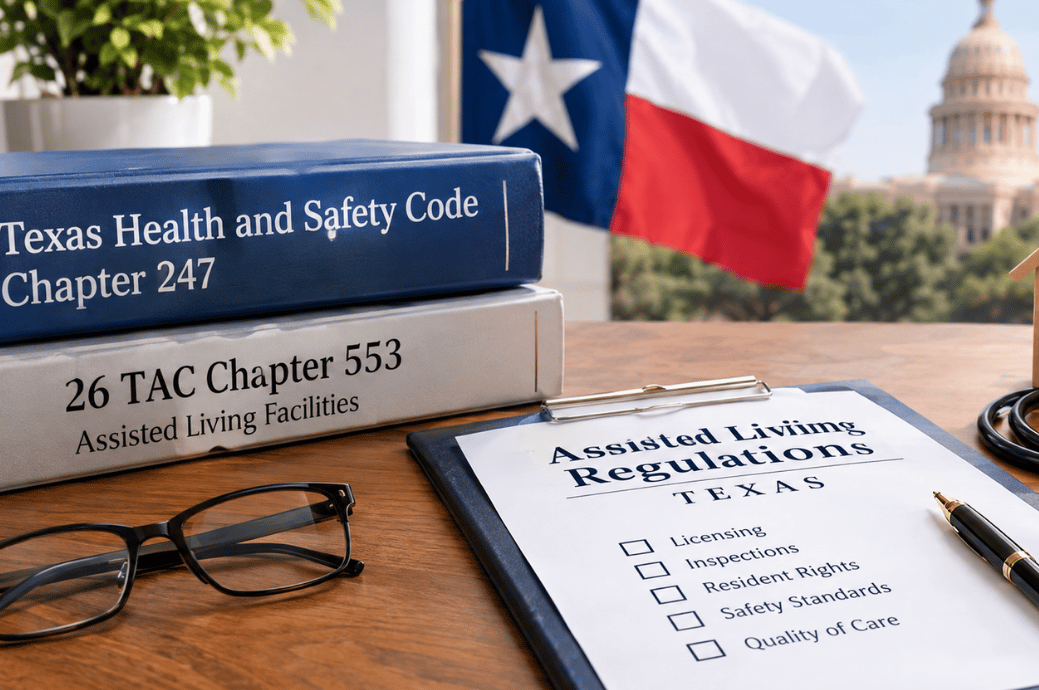
Table of Contents
- Who Regulates Assisted Living in Texas?
- What Are Type A and Type B Assisted Living Facilities?
- Type A Explained
- Type B Explained
- Why the Distinction Matters When Choosing Care
- What Does an Assisted Living License Tell Families?
- How Does HHSC Inspect Assisted Living Facilities?
- What Are Residents' Rights in Texas Assisted Living?
- What Are Texas Assisted Living Facilities Required to Provide?
- What Should Families Check Before Choosing a Texas Assisted Living Facility?
- How Can You Check an Assisted Living Facility's Texas License?
- Frequently Asked Questions
- Making Sense of Texas Assisted Living Regulations
Texas is experiencing rapid growth in its older population, with more than 2,000 licensed assisted living facilities already serving seniors across the state. You will find everything from a converted house with six beds to large campuses where whole wings are set aside for memory care. But the numbers also show the other side of the coin. In fiscal year 2025 the state put in more than 3,000 complaints regarding these facilities and handed out 100 administrative penalties to non-compliant providers. One should not forget that oversight is no mere formality and a license does not equate to quality; it is an ongoing process.
That's why assisted living regulations in Texas matter to your search, not just to the facilities themselves. These rules define the minimums each community must meet, who they can serve, how often the state reviews their work, and what rights your loved one has once they move in.
Tip
Key Takeaways:
1. The Texas Health and Human Services Commission (HHSC) licenses and inspects every assisted living facility in the state under Health and Safety Code Chapter 247 and 26 TAC Chapter 553.
2. Facilities are licensed as Type A or Type B based on residents' ability to evacuate independently and their need for overnight assistance.
3. HHSC inspects every facility at least once every two years, plus any time a complaint comes in, and those reports are public record.
4. Texas residents have specific legal rights covering privacy, dignity, communication with family, and freedom from abuse or neglect.
Who Regulates Assisted Living in Texas?
The Texas Health and Human Services Commission is the state agency responsible for licensing and overseeing every assisted living facility in Texas. HHSC's Long-Term Care Regulatory division handles everything from approving new facilities to investigating complaints at existing ones.
This oversight has a legal foundation in two sources. Texas Health and Safety Code Chapter 247 is the state law that gives HHSC its authority to license and regulate assisted living facilities. Underneath that law sits 26 TAC Chapter 553, the detailed rulebook that spells out exactly what facilities must do: staffing ratios, staff training, medication handling, building safety, resident rights, and more.
These two documents form the basis for Texas assisted living regulations. HHSC uses them to license new facilities, renew existing licenses, conduct routine inspections, and enforce when a facility doesn't measure up. If a community can’t produce a current HHSC license, that should be a red flag, not just a paperwork problem.
What Are Type A and Type B Assisted Living Facilities?
One of the first things you'll notice when researching Texas assisted living regulations is that facilities aren't licensed as one generic category. HHSC splits them into Type A and Type B, and the difference matters a lot depending on your loved one's needs.
Type A Explained
Consider the Type A license. Under this designation, the residents are typically more mobile and independent. They may want some help in the day with bathing or medication, but they can take direction and would be able to evacuate on their own if an emergency arose, so overnight staff is not required.
Type B Explained
A Type B license is for facilities where residents need staff help to evacuate, may not be able to follow emergency instructions on their own, and require overnight staff attendance. This type of license is generally issued for residents with more advanced physical limitations or cognitive impairment, such as many people living with dementia.
Why the Distinction Matters When Choosing Care
A Type A facility is simply not licensed to offer the sort of supervision you get with a Type B. It doesn’t matter how appealing the apartments are; if your parent has memory issues that cloud their judgment in a crisis or needs assistance to the bathroom after dark, a community made for Type A personalities is not the place for them. Make sure to ask what kind of license they have and press for a straight answer rather than something vague. It will tell you much about the community’s capabilities.
What Does an Assisted Living License Tell Families?
A facility's HHSC license is essentially its permission slip to operate, and it carries four pieces of information worth checking before you tour.
License status tells you whether the facility is active, on provisional status, or facing restrictions. Licensed capacity tells you the maximum number of residents the facility is approved to serve. A community that's over capacity is operating illegally. Facility type confirms whether it's licensed as Type A, Type B, or both, and whether it holds a certified Alzheimer's designation. Renewal status shows whether the license is current or expired.
A license that's active and in good standing is the starting point for your research, not the finish line. It tells you the facility met minimum standards at its last review. It says nothing about staff turnover, the quality of daily activities, or how residents are actually treated day to day. Always ask to see the current license posted in the building, and compare what's posted against what the state's online records show.
How Does HHSC Inspect Assisted Living Facilities?
Texas assisted living regulations require HHSC to inspect every licensed facility on a regular schedule, and those inspections are one of the most useful tools families have.
Routine inspections are scheduled at least every two years and are typically unannounced, meaning the facility is not given advance notice to prepare. Surveyors review resident records, watch staff give medication, inspect the building for safety hazards, and talk directly with residents about their experience.
Complaint investigations happen any time someone: a resident, a family member, a staff member, or even an anonymous tipster, files a complaint with HHSC. These can happen at any point in a facility's licensing cycle and often focus on a specific incident rather than a general review.
Inspectors document deficiencies and corrective actions whenever they find a facility out of compliance with state rules. Facilities must submit a plan to fix the problem, and HHSC follows up to confirm it happened.
Tip
Why is it important to check a facility’s inspection history? One old citation isn’t always a dealbreaker. Still, a pattern of repeat violations in the same area, like medication errors or staffing shortages, is a serious warning sign that should be taken seriously.
What Are Residents' Rights in Texas Assisted Living?
State rules under 26 TAC Chapter 553 spell out specific rights that every licensed facility must honor and post visibly for residents and families.
Residents have the right to privacy, including a private space for personal care and the right to close their door. They have a right to dignity and respect, which means that staff should treat them as adults who can make choices, not just as patients to be managed. Residents have a right to participate in decisions relating to their care, including the review and development of their individualized service plan.
Families should also be aware that residents have the right to request access to their own records, the right to communicate freely with family by telephone, mail or visits without interference from the facility and the right to be free from abuse, neglect and exploitation: physical, emotional or financial. By law, facilities must display a summary of these rights in a public place and staff must be trained on them.
These are not trivial items. If something doesn’t seem right during a visit, if mail seems to be delayed, if access to the telephone is restricted, or if a resident appears afraid to speak freely. These are exactly the protections that Texas’ assisted living regulations were designed to provide.
What Are Texas Assisted Living Facilities Required to Provide?
Beyond licensing categories and resident rights, state rules lay out baseline operational requirements every facility must meet.
Staffing and training rules require enough staff on duty to meet residents' needs around the clock, along with background checks and required training hours, including dementia-specific training for staff working with residents who have Alzheimer's or a related condition. Medication management rules govern how staff assist with, administer, or supervise medications, and require accurate documentation every time.
Personal care and nutrition standards require help with daily activities like bathing and dressing, along with meals that meet basic nutritional guidelines and accommodate common dietary restrictions. Emergency preparedness includes having a written emergency plan, working smoke detectors and fire suppression systems, and periodic fire drills. Building maintenance and sanitation practices are governed by different safety and infection control standards.
Finally, care-planning and resident-records rules require individualized service plans for each resident that are updated as needs change, and that are accurate and accessible. These requirements together set the operational floor that each licensed facility must meet; the best communities are built far above that floor.
What Should Families Check Before Choosing a Texas Assisted Living Facility?
Use this checklist during your research and tours. It's worth printing out and bringing along.
☐ Current HHSC license posted and active
☐ License type (Type A, Type B, or Alzheimer's certified)
☐ Licensed capacity versus current occupancy
☐ Inspection history for the past two to three years
☐ Any complaints or enforcement actions on file
☐ Staff-to-resident ratios, especially overnight
☐ Specific services offered versus your loved one's needs
☐ Written emergency and evacuation procedures
☐ Medication management process and who administers it
☐ Total monthly costs, including any add-on fees
☐ Contract terms, including discharge and move-out policies
You can tick every box on paper and still be the wrong emotional fit, so use this list as a filter, not a final decision. It narrows your options to communities that deserve a longer, closer look.
How Can You Check an Assisted Living Facility's Texas License?
HHSC maintains a free, public database of every licensed long-term care provider in Texas, including assisted living facilities, through its online provider search tools.
Go to the HHSC provider search portal. Search "HHSC long-term care provider search" or visit the Texas Health and Human Services website's provider directory.
Search by facility name, city, or zip code. You can narrow results to assisted living specifically rather than nursing homes or other provider types.
Check the license status and type. Confirm the facility is active and note whether it's Type A, Type B, or Alzheimer's certified.
Review the inspection history. Look for recent survey dates, any cited deficiencies, and whether you corrected them.
Note any complaints or enforcement actions. These are listed separately from routine inspections and are worth reading in full.
Cross-check the license number posted at the facility. During your tour, compare the license displayed on-site with what you found online, it should match exactly.
If you run into trouble navigating the portal or want a second opinion on what you're seeing, a placement advisor familiar with Texas licensing records can walk through it with you.
Frequently Asked Questions
Is assisted living regulated at the federal level in Texas, or only by the state? The state government oversees assisted living. Texas does not regulate assisted living facilities through a federal licensing agency, as nursing homes are regulated under federal Medicare and Medicaid rules. Instead, HHSC and state law oversee them.
How do I file a complaint against a Texas assisted living facility? You can file complaints directly with HHSC by phone or through its online complaint form. You can file complaints anonymously, and HHSC must investigate allegations involving resident safety.
Can a Type B facility care for residents with dementia? “Yes, a lot of our Type B facilities are serving people with dementia, because Type B licensing allows for people who need more supervision. Some facilities also have an additional certified Alzheimer’s designation with extra training and safety standards.
What's the difference between assisted living and a personal care home in Texas? Texas doesn't license a separate category called "personal care home." Facilities offering that level of support are generally licensed as Type A or Type B assisted living facilities under the same HHSC rules.
Are independent living communities regulated the same way as assisted living in Texas? No. Independent living communities do not offer hands-on personal care and are not licensed by HHSC as assisted living facilities. In most cases, a community that helps with daily activities or manages medications must be licensed as an assisted living facility.
Making Sense of Texas Assisted Living Regulations
Making sense of the regulations in Texas gives you an advantage. You will be in a position to spot the red flags and know which documents to put in for. An up to date license and a good inspection report are only the beginning. What you are really looking for in the right community is a cost structure your family can live with over time, a culture of dignity for the residents and, above all, staff you can put your trust in.
Finding the right assisted living community shouldn't feel like a full-time job. Senior Living Communities helps you cut through the noise with a list of licensed, verified communities that actually match what your loved one needs. Not sure where to start? Use our Matching Tool and take our free 2-minute quiz to get matched with communities based on care needs, budget, and location. Ready to tour? Our Tour Companion will help you build a custom checklist of questions that matter most to your loved one, so nothing gets missed during a visit.