What Is Assisted Living in Texas? A Comprehensive Guide
Learn what assisted living means in Texas, how Type A and Type B licensing works, and what services are included — plus how to know when it's time.

Ruby M. · Senior Living Writer
· 10 min read

Table of Contents
- What Assisted Living Means in Texas
- Who Qualifies for Assisted Living Care
- How Assisted Living Is Regulated in Texas
- Type A vs. Type B Facilities: What's the Difference
- Benefits of Assisted Living
- What Services Are Typically Included
- Average Cost of Assisted Living in Texas
- How to Pay for Assisted Living in Texas
- Signs It Might Be Time for Assisted Living
- Assisted Living vs. Independent Living vs. Memory Care in Texas
- What a Typical Day Looks Like
- Frequently Asked Questions
- Finding the Right Assisted Living in Texas
Searching for assisted living in Texas can feel overwhelming, especially when you're trying to make the right call for someone you love (or maybe even for yourself). Between the paperwork, the price tags, and the sheer number of communities scattered across the state, it's easy to feel stuck before you even start.
You don't have to figure it all out today. This guide breaks down everything step by step: costs, care levels, what to look for on a tour, and questions worth asking, so you can move forward with confidence, not stress.
Tip
Key Takeaways:
1. Assisted living in Texas provides housing, meals, and personal care support in a homelike setting — not the same as a nursing home.
2. Texas licenses facilities as Type A or Type B, based on a resident's ability to evacuate independently and whether they need nighttime supervision.
3. The Texas Health and Human Services Commission (HHSC) regulates all assisted living facilities under Texas Administrative Code, Title 26, Chapter 553.
4. Monthly costs in Texas typically run below the national average, though pricing varies significantly by city.
What Assisted Living Means in Texas
Assisted living in Texas is a type of long-term care that combines private or semi-private housing with assistance with daily tasks such as bathing, dressing, medication management, and meals. It sits between independent living and skilled nursing care, enough support to stay safe, not so much that independence gets lost in the process.
Communities tend to be apartment-style, with residents living in their own space but sharing common areas such as dining rooms and activity lounges. The role of the carers is to help as needed but not to take over daily life. It’s about making the parts that have become difficult a little easier.
This is different from a nursing home, which provides a higher level of medical care for residents who need 24/7 skilled nursing. Assisted living is for someone who requires assistance with daily activities.
Who Qualifies for Assisted Living Care
Understanding what assisted living is in Texas also means understanding who it's for. There's no single profile of someone who moves into assisted living. Some residents need a little help with medication reminders and transportation. Others need more hands-on support with bathing, dressing, or getting around safely.
Generally, assisted living fits someone who can no longer safely manage daily tasks alone but doesn't require the intensive medical care provided in a nursing home. A physician or placement specialist can help assess where a specific person's needs fall, since the right level of care depends on mobility, cognitive health, and the level of day-to-day support needed.
How Assisted Living Is Regulated in Texas
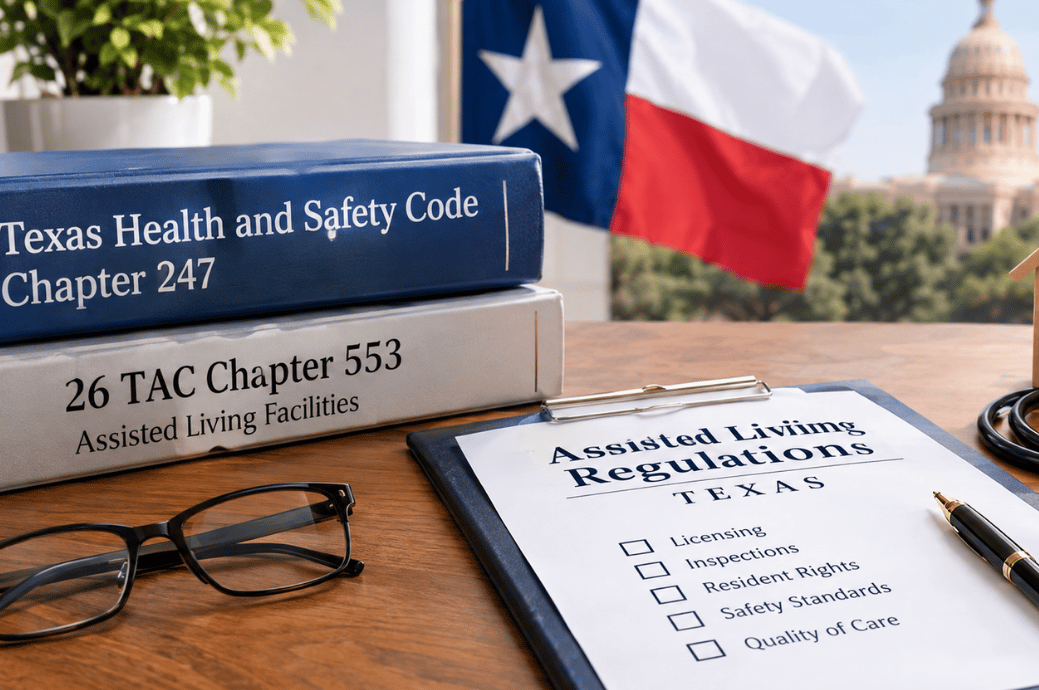
The Texas Health and Human Services Commission (HHSC) licenses all assisted living facilities in Texas. Licensing is governed by the Texas Health and Safety Code, Chapter 247, and specific rules that guide daily operations are located in the Texas Administrative Code, Title 26, Chapter 553.
These rules cover everything from staffing ratios and medication administration to fire safety and resident rights. Facilities are inspected regularly; routine licensing surveys occur at least once every two years, with additional inspections triggered by complaints or specific concerns.
This regulatory structure is one reason understanding what assisted living in Texas differs slightly from researching it in another state. Texas doesn't just license "assisted living" as one category, it splits facilities into two license types based on the physical and cognitive needs of the residents they're allowed to serve.
Type A vs. Type B Facilities: What's the Difference
This is where Texas's system gets specific, and it's worth understanding before you start touring communities.
Type A facilities serve residents who can evacuate the building on their own in an emergency and can follow directions without staff assistance. Type A communities aren't required to have a nurse on-site overnight, though a staff member must be reachable at all times.
Type B facilities serve residents who need physical assistance to evacuate, are unable to follow emergency directions independently, or require night attendance. Type B facilities have more robust overnight staffing requirements built into their license, since their residents typically need more hands-on support.
A Type B license also allows a facility to operate a certified memory care unit for residents living with Alzheimer's disease or another form of dementia, since those residents often need continuous supervision.
Tip
The practical takeaway: a facility's license type isn't just a regulatory detail, it tells you which residents that community is legally allowed to serve. If your loved one needs help evacuating in an emergency, a Type A facility isn't a safe fit, no matter how nice the amenities look on a tour. Asking directly about the license type and honestly matching it to your loved one's mobility and cognitive needs is one of the most useful questions you can bring to a tour.
Benefits of Assisted Living
For many families, the decision to move a loved one into assisted living comes with a mix of relief and guilt. Part of answering what assisted living in Texas actually offers is knowing what the environment is designed to provide, day to day.
Built-in community. Isolation is common among older adults living alone, especially after a spouse passes away or friends move away. Assisted living puts daily social connection back within reach: shared meals, group activities, and simply having people around.
No more house upkeep. Yard work, home repairs, and general maintenance disappear from the to-do list. For a lot of residents, that alone is a weight lifted.
Support without losing independence. Caregivers are there for what's needed: help getting dressed, a reminder for medication, assistance getting to the dining room, without taking over the parts of daily life a resident can still manage on their own.
Built-in safety net. Staff is on-site to respond if something goes wrong, which brings peace of mind to both residents and the family members who used to worry from a distance.
What Services Are Typically Included
Most assisted living communities in Texas build a base set of services into the monthly rate:
A private or shared apartment
Three meals a day, plus snacks
Help with bathing, dressing, and toileting
Medication administration or supervision
Weekly housekeeping and laundry
Transportation to appointments and errands
Access to social, wellness, and recreational activities
24-hour staff availability and emergency response
More specialized care, like memory care support or a higher level of personal assistance, is often billed separately, based on an individual assessment of need. It's worth asking any community for a full breakdown of what's bundled into the base rate before comparing prices across your options.
Average Cost of Assisted Living in Texas
Cost is often the first practical question families ask once they understand what assisted living in Texas is and what it actually provides. Texas assisted living tends to run below the national average, though it varies widely by city.
Selected City | Estimated Monthly Median Cost |
Austin | $6,750 |
Dallas | $6,000 |
Houston | $6,395 |
San Antonio | $5,885 |
Corpus Christi | $4,125 |
Tyler | $6,381 |
McAllen | $8,158 |
Lubbock | $5,986 |
Killeen | $5,590 |
Beaumont | $5,049 |
Estimated costs Based on CareScout's data
Austin tends to have the highest prices due to rapid growth and a competitive labor market, while West Texas cities generally offer the most affordable options in the state. For a full breakdown of what drives these numbers city by city, see our complete guide to assisted living costs in Texas.
How to Pay for Assisted Living in Texas
Most families combine more than one funding source to cover the cost of assisted living. A few of the most common:
STAR+PLUS Medicaid Waiver. Regular Texas Medicaid doesn't cover assisted living directly, but the STAR+PLUS HCBS Waiver can help cover care services, like personal care assistance and medication management, for eligible residents. It doesn't cover room and board, and enrollment is limited, so there's often a waitlist.
VA Aid & Attendance. Veterans and surviving spouses may qualify for an added VA pension benefit that helps offset assisted living costs.
Long-term care insurance. If a policy was purchased years ago, it may cover a meaningful portion of monthly costs, depending on the terms.
Home equity or a home sale. Many families use proceeds from selling a home or from a reverse mortgage to help fund the transition to assisted living.
Medicare, notably, does not cover the cost of assisted living itself, though it can cover certain outpatient therapy services or durable medical equipment.
Signs It Might Be Time for Assisted Living
It's not always one dramatic event that signals it's time. More often, it's a pattern of smaller things adding up:
Missed or mismanaged medications
A recent fall, or a growing fear of falling
Noticeable weight loss or skipped meals
A home that's becoming harder to keep clean and safe
Withdrawing from friends, hobbies, or social activities
Increasing difficulty with bathing, dressing, or personal hygiene
A family caregiver who's feeling stretched thin or burned out
If a few of these sound familiar, it doesn't necessarily mean assisted living is the only answer, but it's a good reason to start the conversation and explore options before a crisis forces a decision.
Assisted Living vs. Independent Living vs. Memory Care in Texas
These three terms get used interchangeably, but they describe different levels of care.
Independent living is designed for active seniors who don't need daily personal care assistance but want a maintenance-free lifestyle with built-in social opportunities.
Assisted living provides hands-on support with daily activities such as bathing, dressing, and medication management, while still encouraging independence wherever possible.
Memory care is a specialized form of care for residents with Alzheimer's or another form of dementia, offering secured environments and staff trained specifically in dementia care.
Many Texas communities offer more than one of these under the same roof, which can make it easier for a resident to transition to a higher level of care later without a full relocation. If you're not sure which fits, our guide to independent living in Texas breaks down that option in more detail.
What a Typical Day Looks Like

Mornings often begin on the resident’s own timetable, with staff available to help with dressing, taking medication, or getting to breakfast for those who wish it. Meals are usually served restaurant-style, in a communal dining room, with menu choices and adaptive assistance available if needed.
Afternoons might include a fitness class, a scheduled outing, a visit to the on-site salon, or simply quiet time in a resident's apartment. Many communities run a full activity calendar: book clubs, live music, game nights, and spiritual services are common, so residents can join as much or as little as they'd like.
The overall rhythm is meant to feel like life, not a facility. Support is there when it's needed, but the day is still the resident's own.
Frequently Asked Questions
What is the difference between Type A and Type B assisted living in Texas? Type A is for residents who can evacuate on their own and do not need overnight attendance. Type B is for residents who need staff assistance to evacuate, who cannot evacuate on their own following emergency instructions, and require overnight supervision.
How do I know what kind of license my parent requires? It’s whether they can get themselves out in an emergency and follow directions on their own. An honest assessment can be made by a placement specialist, a doctor, or the community during a tour or an intake evaluation.
Can a Type A facility become Type B later? Yes, a Type A facility could be converted to a Type B at a later date. A facility may have a Type B license if it meets the additional staffing and physical plant requirements. Still, a resident whose needs are above and beyond Type A criteria will generally need to move to a Type B community, not for the facility to “convert” around one resident.
Is assisted living covered by Texas Medicaid? Regular Medicaid doesn’t directly cover assisted living, but the STAR+PLUS HCBS Waiver can help pay for care services for eligible residents. Room and board is not provided.
Finding the Right Assisted Living in Texas
Choosing assisted living in Texas is about finding the right balance of care, comfort, safety, and cost. Start by understanding your loved one's needs, comparing communities and license types, and looking beyond the monthly rate to see what services are included. With the right information and a thoughtful approach, you can find a community that supports independence while providing the care and peace of mind your family needs.
Every family's situation looks different, and the right community depends on more than the monthly rate. Seniors Living Communities lets you search and compare communities near you by city, budget, and care type. Take a quiz using our free Matching Tool to get connected with assisted living communities that fit your loved one's needs and budget, and bring our Tour Companion along when you visit to help you ask the right questions and compare communities with confidence.
The quiz is 100% free, takes about two minutes, and you decide which communities are allowed to contact you.